Orderly Product Collation & Secondary Packaging Solution
What Is Orderly Product Collation & Secondary Packaging Solution?
An orderly product collation and secondary packaging solution organizes individual products into a fixed pattern before creating a larger package.
The incoming products may already be individually wrapped, or they may be unpackaged items that need to be grouped before entering the next packaging stage.
Depending on the application, products may need to be:
- Counted into a fixed quantity
- Aligned in the same direction
- Turned to a defined orientation
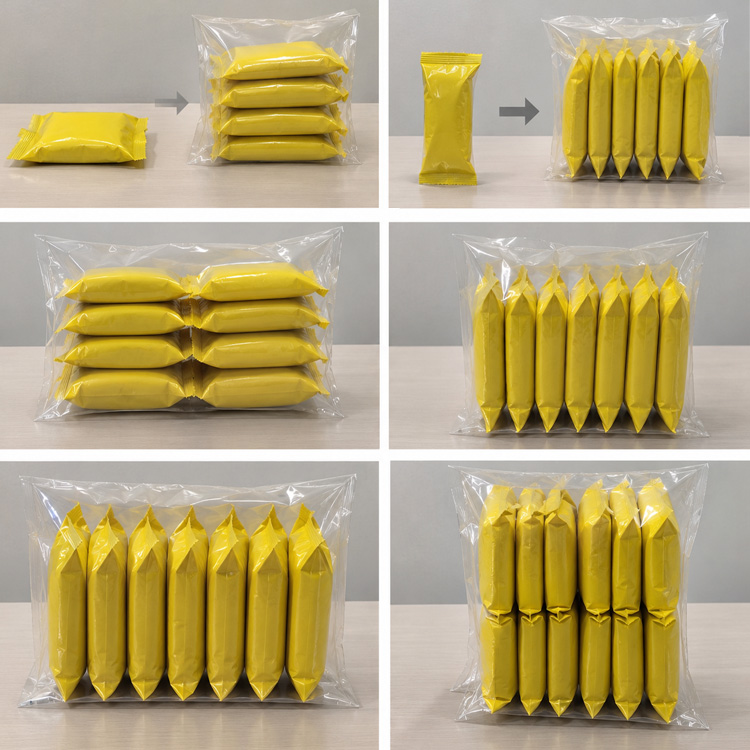
- Arranged in one or several rows
- Stacked vertically
- Overlapped in a controlled pattern
- Grouped into bundles
- Transferred into bags, film, cartons, or trays
The main challenge is keeping the group stable between collation and packaging.
A stack of biscuits can tilt during transfer. Lightweight disposable products may shift when pushed. Soft bakery products can deform under excessive pressure. Individually wrapped products may slip against each other because of the film surface.
The feeding, grouping, transfer, and packaging sections therefore need to be designed as one connected process.
This type of solution is suitable when the number, position, and arrangement of products inside every finished pack must remain consistent.
How to Choose the Right Orderly Product Collation & Secondary Packaging Solution?
The solution should be selected according to both the individual product and the required finished group.
Manufacturers should consider:
- Product dimensions and weight
- Product rigidity or softness
- Surface friction
- Fragility and allowable transfer pressure
- Incoming product direction
- Incoming spacing and production rate
- Number of production lanes
- Products per finished pack
- Required row or stack arrangement
- Maximum acceptable stack height
- Flow wrapping, bagging, or cartoning format
- Need for product orientation
- Need for robotic handling
- Required changeover frequency
- Inspection requirements
- Downstream case packing
- Available installation space
A flat, rigid product may be stacked and mechanically transferred at high speed. A soft bakery item may need gentler grouping and fewer products per stack. A slippery retail pack may require additional support throughout the transfer process.
The best configuration is determined by testing how the actual products behave during counting, grouping, stacking, and movement into the final package.