
- Home
- News
- Industry insights
-
Packaging Materials for Bread
Packaging Materials for Bread
The right packaging material for bread depends on the bread's moisture, crust, formulation, temperature at packing, desired texture, required storage period and distribution conditions. Soft sliced bread usually needs protection against moisture loss, while crusty products may need controlled moisture release to avoid a soft or leathery crust. Material selection is therefore a moisture-balancing and process decision—not simply a search for the highest possible barrier.
Quick answer: Bread packaging should match the product's dominant quality risks. Water-vapor barrier, oxygen barrier, sealability, mechanical protection and machinability all matter, but their required balance changes by bread type. Final performance must be validated with the real bread, selected material, packaging process and expected distribution environment.
Start with the Bread, Not the Film Name
Two bread products can require different packages even when their dimensions are similar. A sliced sandwich loaf, crusty roll, soft bun, flatbread and filled bakery product differ in moisture content, crust-to-crumb ratio, sensitivity to compression and microbial risk.
Before comparing materials, define:
- whether the target texture is soft, crisp, crusty or mixed;
- product temperature and moisture condition at packing;
- whether the bread is sliced, unsliced, filled or topped;
- expected time from baking to packing;
- required storage and distribution period;
- ambient temperature and humidity exposure;
- opening and reclosing behavior;
- microbial-control and food-safety requirements;
- pack appearance, print and retail-display needs;
- packaging-line and sealing conditions.
The material specification should follow these requirements.
Water-Vapor Barrier Is a Moisture-Control Decision
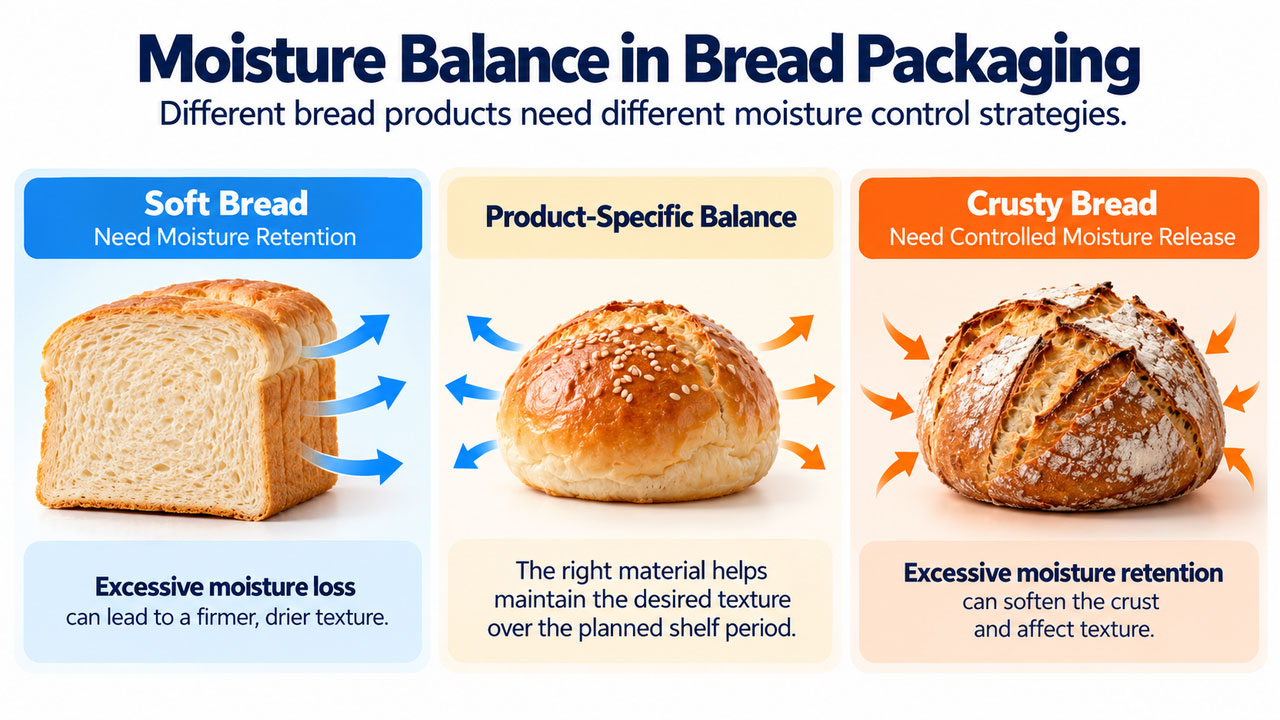
Water vapor can move through packaging material, closures and imperfect seals. For soft bread, excessive moisture loss can contribute to a firmer, drier product. A package with suitable water-vapor resistance can slow exchange with the surrounding environment.
For crusty bread, however, trapping moisture can soften the crust. Research on bakery packaging describes bread as a moisture-balancing application: some products benefit from moisture retention, while others require controlled release. Perforation, paper combinations or materials with different permeability may therefore be considered for particular crusty products.
This means lower water-vapor transmission is not automatically better. Packaging teams need to define how much moisture change the product can tolerate and how the package should behave over the intended distribution period.
Oxygen Barrier Has a Different Job
Oxygen barrier can matter when oxidation, aroma loss, mold-control strategy or a modified atmosphere is part of the product system. It should not be confused with water-vapor barrier: a material may perform differently against different gases and moisture.
If modified-atmosphere packaging or oxygen management is proposed, the evaluation should include material permeability, initial gas condition, headspace, seal integrity, leakage, product response and storage temperature. Packaging atmosphere cannot replace formulation, hygiene, preservatives where applicable or validated microbial controls.
No general web article can specify a universal oxygen-barrier value or gas mixture for every bread product. These are product-development and validation decisions.
Sealability Turns Material Properties into Package Performance
Barrier values describe the material under specified test conditions. The finished pack also depends on the seal.
Important sealing factors include:
- sealant-layer compatibility;
- usable temperature window;
- dwell time and pressure;
- film thickness and structure;
- contamination, crumbs or folds in the seal area;
- film tension, tracking and registration;
- closure type for bags that are clipped, taped or otherwise reclosed;
- resistance to handling and flexing after sealing.
A high-barrier material with inconsistent seals may provide poorer protection than expected. Testing should therefore include both material data and finished-package integrity.
Product Temperature and Cooling Affect the Package Environment
Bread can continue releasing heat and moisture after baking. If it is packaged before reaching a suitable condition, moisture may collect inside the package or change the local humidity around the product. That can affect texture, appearance and microbial risk.
The acceptable packing temperature cannot be set universally. It depends on product size, formulation, cooling process, room conditions, package permeability and target shelf life. The engineering requirement is a repeatable cooling endpoint and a packaging process that receives product within the validated range.
Cooling, accumulation and transport to the wrapper should be evaluated together. A material change alone cannot correct an unstable product temperature at the infeed.
Mechanical Protection and Package Fit
Bread packaging must also survive feeding, sealing, secondary packing and distribution. Soft loaves may deform under pressure. Crusty products can shed particles. Sliced products may shift, and buns may vary in height or orientation.
The package should provide enough space for the product and sealing process without using excessive material or allowing uncontrolled movement. Relevant properties may include puncture resistance, tear behavior, stiffness, coefficient of friction and resistance to flex cracking.
Package dimensions also affect film use, headspace, presentation and machine settings. Material and pack geometry should be evaluated together rather than as separate purchasing decisions.
Common Bread-Packaging Material Directions
Bread is packaged in a range of paper-based and polymer-based structures, including polyethylene families, polypropylene structures and multilayer combinations. Some applications use perforated films or paper combinations; others require stronger moisture or gas barriers.
Material names alone are not enough to select a structure. Resin grade, thickness, coatings, layer combination, additives, printing and conversion process can change performance. Regulatory suitability, recycling or recovery requirements, local collection systems and supplier consistency also need review.
Sustainability decisions should compare material reduction and end-of-life goals with product protection. A package that causes higher product waste may not improve the overall environmental result. Conversely, unnecessary over-packaging should not be justified without a demonstrated product requirement.
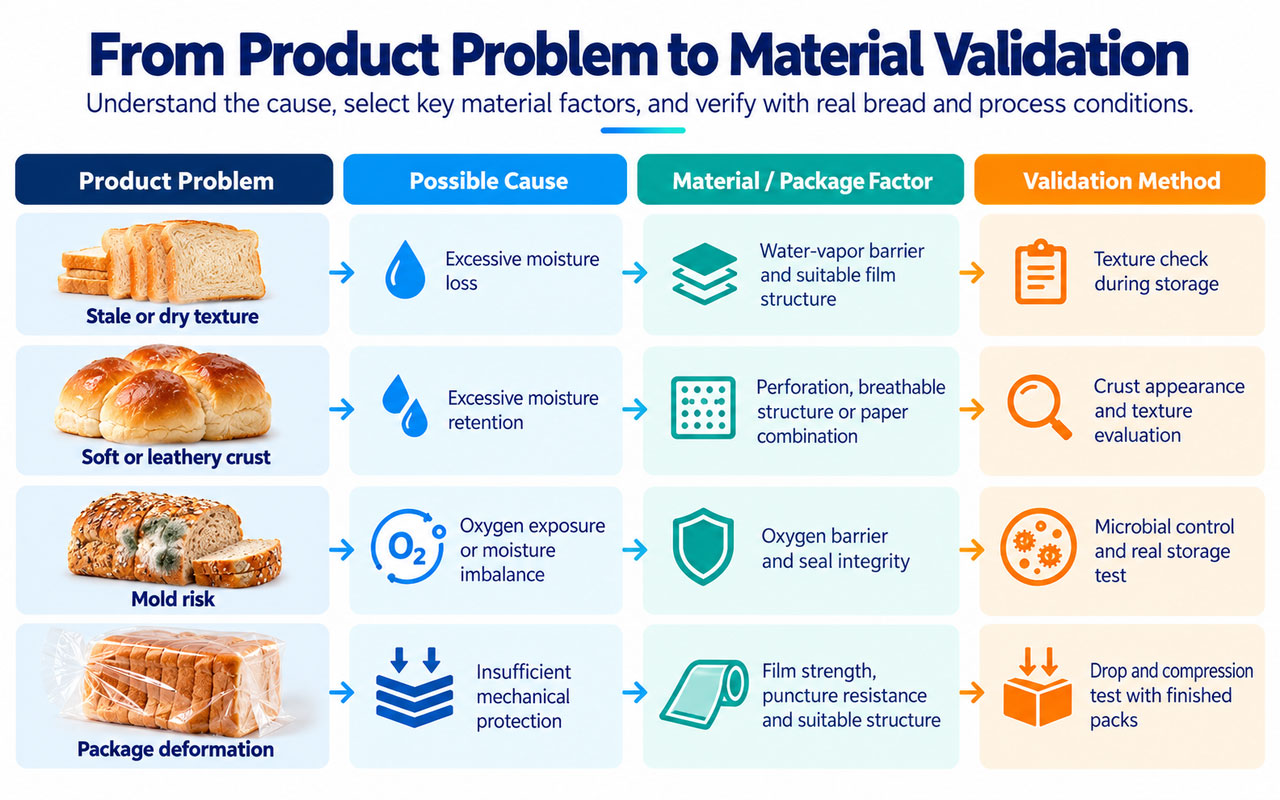
Problem to Packaging Requirement
| Product or package problem | Possible cause | Material or package factor | Validation need |
| Soft bread dries or firms too quickly | Moisture loss plus product staling mechanisms | Water-vapor barrier, closure and seal integrity | Texture and moisture testing over expected storage |
| Crust becomes soft | Moisture retained or redistributed | Permeability, perforation and product cooling | Crust texture under representative conditions |
| Condensation appears | Product packed too warm or temperature cycling | Cooling endpoint, package permeability and headspace | Production and distribution temperature trial |
| Mold develops | Product, hygiene and microbial-growth conditions | Seal integrity, atmosphere and validated control system | Product-specific microbial shelf-life study |
| Packs leak intermittently | Seal contamination, wrinkles or material damage | Sealant, sealing window, tracking and handling resistance | Finished-package integrity testing |
| Bread is crushed or distorted | Pack geometry or handling pressure | Film behavior, dimensions and secondary protection | Real-line and distribution test |
The table is a diagnostic framework, not a promise that a material change will solve every problem.
A Practical Material-Validation Plan
Begin with a small number of candidate structures selected against the product requirements. Use representative bread and normal production variation, not only ideal samples.
Record:
- bread type, formulation reference and condition at packing;
- cooling time and product temperature;
- material structure, thickness and supplier data;
- packaging-machine settings and line speed;
- seal appearance and integrity observations;
- package dimensions and closure method;
- storage temperature and humidity;
- texture, moisture, water activity or other approved quality measures;
- visible condensation, mold, leakage or physical damage;
- results after representative transport or handling.
When a candidate fails, identify whether the dominant cause is product formulation, cooling, material transmission, seal integrity, mechanical damage, storage or microbial control. That prevents the team from changing equipment or material without diagnosing the actual failure path.
From Material Requirement to Packaging Process
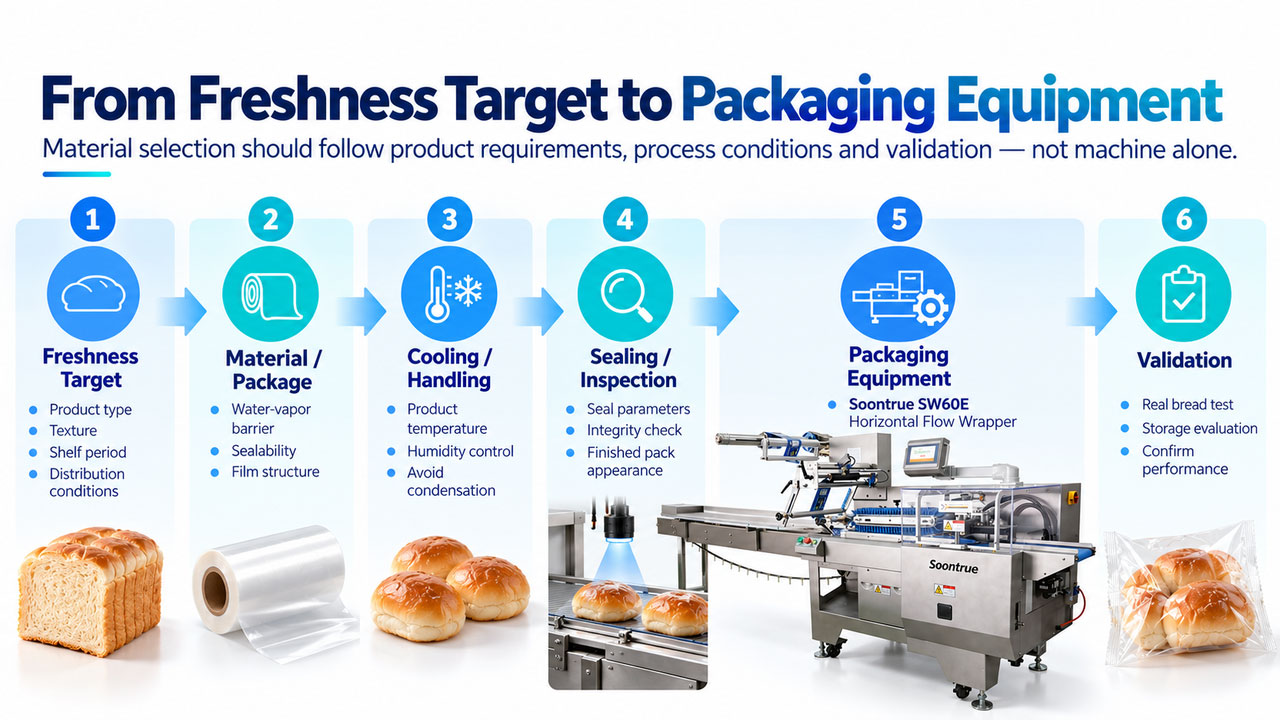
The engineering sequence is:
Product freshness target → material and package requirement → cooling and handling process → sealing and inspection → equipment configuration → real-product validation
Equipment selection comes after the material, package and process requirements are sufficiently clear. Readers planning a wider bakery line can continue to Soontrue Group's Bakery Packaging Solution page for feeding, primary packaging and downstream integration context.
FAQ
A1: What is the best packaging material for bread?
There is no universal best material. The correct structure depends on bread type, desired texture, moisture balance, storage period, sealing process and distribution environment.
A2: Does bread packaging need a moisture barrier?
Many soft breads benefit from controlled moisture retention, but crusty products may require moisture release. The required water-vapor performance must be defined for the specific bread.
A3: Is oxygen-barrier packaging necessary for bread?
It depends on oxidation risk, aroma, microbial-control strategy and whether a modified atmosphere is used. Oxygen barrier and water-vapor barrier address different transfer mechanisms.
A4: Can warm bread be sealed in a bag?
Packaging bread while it is still releasing substantial heat and moisture can change package humidity and increase condensation risk. Establish and validate an acceptable cooling endpoint.
A5: How should bread packaging material be tested?
Test candidate materials with the real bread, intended package dimensions, production sealing conditions and expected storage and distribution profile. Evaluate the finished package, not only supplier data.