
- Home
- News
- Industry insights
-
Why Does Bread Go Stale?
Why Does Bread Go Stale?
Bread goes stale because its internal structure continues to change after baking. The process is driven mainly by starch retrogradation and moisture redistribution, not simply by the bread "drying out."
As bread cools and sits, gelatinized starch molecules gradually reorganize into a more ordered structure. At the same time, water moves between the crumb, crust, packaging environment and other components inside the bread. Together, these changes make the crumb firmer and less elastic, while the crust may gradually lose its crisp texture.
Packaging can slow some freshness losses by controlling moisture exchange, protecting the product and maintaining seal integrity, but it cannot completely stop the structural changes responsible for bread staling.
The Short Answer: Bread Staling Is a Structural Change
Fresh bread contains a soft network of gelatinized starch, proteins, air cells and water. This structure is not permanently fixed after baking.
During storage, part of the starch—especially amylopectin—gradually reassociates and recrystallizes. Food scientists commonly refer to this process as starch retrogradation.
As retrogradation progresses, the crumb becomes firmer and its ability to spring back after compression decreases.
This is why bread can become stale even when it is stored in a sealed package. A package can reduce moisture exchange with the surrounding environment, but it cannot completely prevent the internal structural changes taking place inside the bread.
Moisture movement is the second important part of the process. Water moves from the crumb toward the crust and may also escape through the packaging material. At the same time, moisture is redistributed among starch, proteins and other components inside the bread.
For this reason, bread staling should be understood as the combined effect of starch structural changes and moisture redistribution, rather than moisture loss alone.
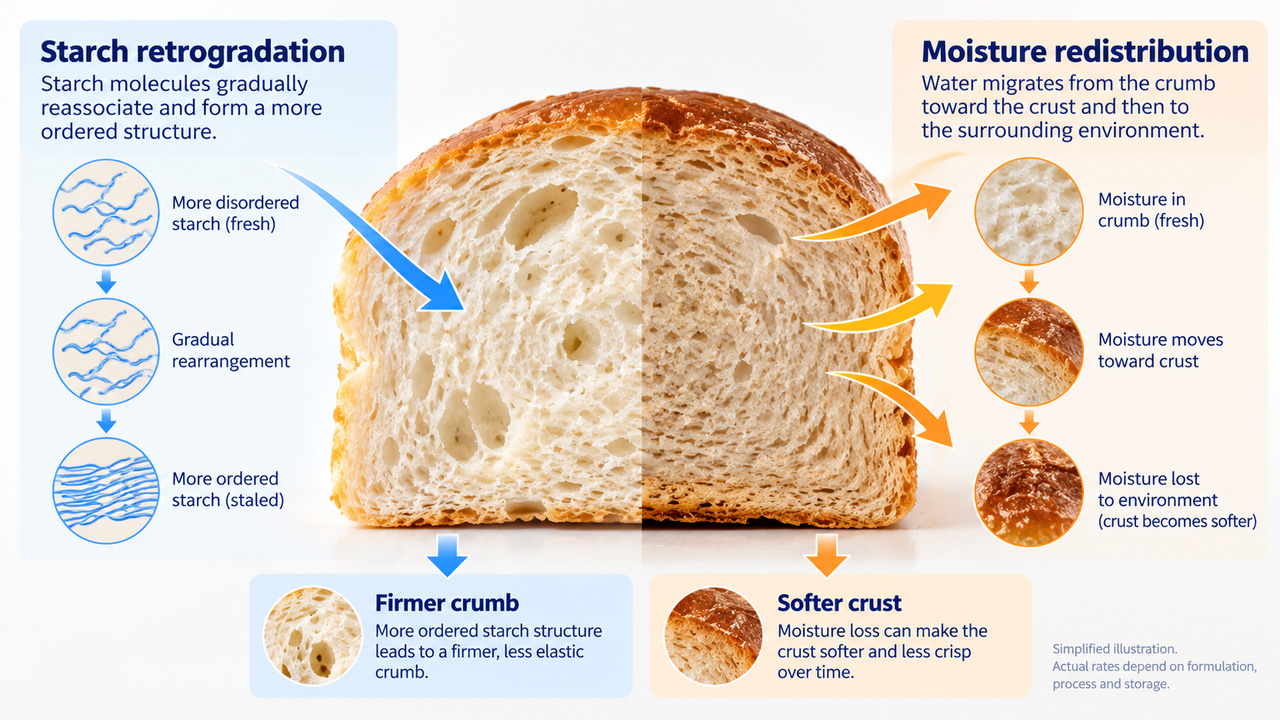
Why Does the Crumb Become Firm While the Crust Becomes Soft?
The crumb and crust leave the oven with very different moisture levels.
The crumb normally contains considerably more water, while the crust has a much lower moisture content and a dry, brittle structure.
During storage, moisture gradually moves from the wetter crumb toward the drier crust.
This redistribution can contribute to two changes happening at the same time:
- - the crumb becomes firmer and less elastic;
- - the crust absorbs moisture and loses crispness.
For crusty rolls or similar bakery products, this can seem contradictory: the inside feels progressively firmer while the outside becomes softer.
The extent of these changes depends heavily on the product.
A sliced sandwich loaf, brioche, hamburger bun, crusty roll and filled pastry differ in formulation, moisture content, crust structure and geometry. Therefore, they should not automatically be expected to require the same packaging conditions.
Is Stale Bread the Same as Moldy Bread?
No.
Bread staling is primarily a texture and quality change, while mold is microbial growth.
Bread can become stale without showing any visible mold, and mold can develop before a consumer considers the bread stale.
For bakery manufacturers, this distinction is important because texture retention and microbial shelf life are two different validation problems.
A packaging system that reduces moisture loss does not automatically provide sufficient microbial control. Likewise, a formulation or preservation method used to control mold does not automatically prevent starch retrogradation or crumb firming.
Visible mold should also not be treated as only a surface defect. According to USDA guidance, moldy bread and other porous foods should generally be discarded because fungal growth may extend below the visible surface.
What Affects the Rate of Bread Staling?
There is no universal number of days before bread becomes stale.
The rate depends on the interaction of product formulation, processing conditions, packaging and storage environment.
Important variables include:
- Bread formulation: Flour characteristics, starch composition, fats, sugars, proteins, enzymes and emulsifiers can influence texture changes during storage.
- Baking conditions: Final moisture content, crust development and bake profile affect how the product behaves after cooling.
- Cooling before packaging: Product temperature at the time of packing can influence condensation, seal performance and the package environment.
- Product geometry: Sliced loaves, individual buns and smaller bakery products have different surface-area-to-volume ratios and crumb-to-crust proportions.
- Storage temperature: Temperature affects starch retrogradation as well as microbial growth.
- Packaging barrier: The film structure influences the rate at which water vapor and gases move between the package and the surrounding environment.
- Seal integrity: Even an appropriate packaging film cannot perform as intended if seals are inconsistent or contaminated.
- Time after opening: Once the original package has been opened, the surrounding environment and the way the package is reclosed become increasingly important.
Because these variables interact, shelf-life claims from one bakery product should not automatically be applied to another without product-specific testing.
How Packaging Influences Bread Freshness
Packaging does not completely prevent bread staling.
Its main role is to help control the environment around the product.
Depending on the bakery product and shelf-life target, packaging can help:
- reduce moisture exchange with the surrounding environment;
- protect bread from contamination;
- maintain an intended package atmosphere;
- reduce physical damage during transport and handling;
- maintain package integrity through consistent sealing.
For example, a packaging film with an appropriate water-vapor barrier can reduce moisture loss from the bread.
However, the highest possible barrier is not automatically the best packaging solution.
A warm loaf placed into a highly sealed package may create condensation. A crusty product may require a different moisture balance from a soft sandwich loaf. Products with fillings or different water activities may introduce additional microbial and storage requirements.
Packaging decisions therefore need to be evaluated together with product formulation, cooling conditions, hygiene, distribution environment and required shelf life.
From Bread Freshness to Packaging Requirements
For bakery manufacturers, a freshness problem should first be translated into measurable packaging requirements.
Instead of starting with the question:
"Which packaging machine should we use?"
it is usually more useful to begin with:
"What freshness problem are we trying to control?"
For example:
Crumb becoming too firm
→ evaluate formulation, storage temperature, moisture migration and packaging barrier.
Crust becoming too soft
→ evaluate moisture redistribution and the required moisture transmission characteristics of the package.
Condensation inside the package
→ check product temperature at packing, cooling conditions, film properties and sealing timing.
Package leakage
→ evaluate film compatibility, sealing temperature, seal pressure, dwell time and contamination in the seal area.
Mold or microbial shelf-life concerns
→ evaluate the complete product, formulation, hygiene, packaging atmosphere and storage system rather than relying on the packaging film alone.
This distinction is important because different freshness problems may require very different packaging responses.
What Bakery Packaging Teams Should Evaluate
Once the freshness target has been defined, the bakery and packaging teams can evaluate the complete product-package-process system.
Important questions include:
Product
- What type of bread or bakery product is being packed?
- What are its dimensions and weight?
- Is the product sliced, filled, coated or topped?
- How easily is it compressed or damaged?
Product Condition at Packing
- What is the product temperature?
- Has the bread completed the required cooling stage?
- Is there visible surface moisture?
- Is condensation likely to form after sealing?
Packaging Material
- What water-vapor barrier is required?
- What level of gas transmission is appropriate?
- Is the film compatible with the intended sealing system?
- Does the package provide sufficient puncture and handling resistance?
Packaging Process
- Can the feeding system handle the product without deformation?
- Is film tracking stable?
- Is film tension appropriate?
- Are crumbs, oil or product residue entering the sealing area?
- Are seals consistent throughout normal production speeds?
Distribution
- How long will the product remain in the supply chain?
- What temperature and humidity conditions will it experience?
- How much mechanical handling will the package receive?
Packaging performance should therefore be validated using the actual bakery product, selected film, packaging line, production speed and expected distribution conditions.
Can Packaging Slow Bread Staling?
Packaging can slow some of the changes associated with loss of freshness, particularly moisture exchange with the environment.
However, packaging cannot completely stop starch retrogradation inside the bread.
This means a well-sealed package may help the bread retain moisture while the crumb still gradually becomes firmer during storage.
For bakery manufacturers, this is why shelf-life development should evaluate both product texture and package performance rather than considering packaging alone.
What Type of Packaging Keeps Bread Fresh Longer?
There is no single packaging material that is best for every type of bread.
The correct structure depends on factors such as:
- bread formulation;
- target texture;
- required shelf life;
- moisture sensitivity;
- sealing requirements;
- distribution environment;
- production speed.
A soft sandwich loaf, for example, may require a different moisture-management strategy from a crusty bread or filled bakery product.
Packaging material selection should therefore be based on measurable product and shelf-life requirements rather than simply choosing the film with the highest barrier specification.
Can Packaging Bread While It Is Warm Cause Condensation?
Yes.
If bread enters a sealed package while it is still too warm, water vapor released by the product may condense as the product and package cool.
Condensation can affect package appearance and may also change the internal moisture environment.
For this reason, cooling conditions and product temperature at the packaging point should be included in packaging validation.
The correct packing temperature depends on the specific bakery product, process and packaging system and should be confirmed through production testing.
A Practical Next Step
Before selecting bakery packaging equipment, define the freshness problem in measurable terms.
Is the main issue:
- crumb firmness;
- moisture loss;
- loss of crust crispness;
- condensation;
- mold;
- package leakage;
- seal contamination;
- or physical damage?
Each problem points to a different packaging investigation.
The next step is to connect these freshness requirements with packaging material properties.
Read next:
Packaging Materials for Bread: Barrier, Sealability and Shelf-Life Considerations
For a broader overview of bakery and food packaging systems, see Soontrue Group's Food Packaging Solutions.
FAQ
Q1: Why does bread go stale?
A1: Bread goes stale mainly because starch inside the crumb gradually reorganizes through starch retrogradation while moisture is redistributed between the crumb, crust and surrounding environment.
Q2:Does bread go stale only because it loses water?
A2: No. Moisture loss can contribute to firmness, but starch retrogradation and internal moisture redistribution are also major mechanisms involved in bread staling.
Q3:Can bread become stale inside a sealed package?
A3: Yes. A sealed package can reduce moisture exchange with the environment, but starch retrogradation and internal moisture movement can still occur.
Q4: Does packaging slow bread staling?
A4: Packaging can slow moisture exchange and help maintain the intended product environment, but it cannot completely prevent the structural changes responsible for bread staling.
Q5: What packaging is best for bread?
A5: There is no universal best packaging material. The appropriate film and package structure depend on the bread type, moisture target, required shelf life, sealing conditions and distribution environment.
Q6: Can warm bread be packaged immediately?
A6: Packaging bread before sufficient cooling may increase the risk of condensation inside the package. The appropriate packing temperature should be determined for the specific product and production process.
Q7: Is stale bread unsafe to eat?
A7: Staling itself is mainly a quality and texture change and is different from microbial spoilage. Food safety depends on the product, ingredients, storage conditions and signs of spoilage. Bread with visible mold should be discarded rather than trimmed.
Q8: Does refrigeration keep bread fresh longer?
A8: Refrigeration may be necessary for certain filled or perishable bakery products, but ordinary bread can firm more rapidly under some refrigerated conditions. Storage recommendations should therefore be determined for the specific product.