
- Home
- News
- Industry insights
-
End-of-Line Packaging Automation: When to Integrate Case Erecting, Packing, Sealing, and Palletizing
End-of-Line Packaging Automation: When to Integrate Case Erecting, Packing, Sealing, and Palletizing
End-of-line packaging automation should be integrated when secondary and end-of-line packaging solutions need to connect case supply, product collation, packing, sealing, labelling, palletizing, and warehouse handoff as one controlled flow. Integration is most valuable when SKU and case variation create repeated interface losses or when responsibility is fragmented across several suppliers. It is not automatically the right answer for every plant. The decision depends on product stability, production mix, layout, staffing, recovery requirements, and whether the buyer can define one acceptance basis for the complete end-of-line scope.
PMMI's 2026 report notes increasing convergence of case erecting, packing, sealing, and robotic palletizing, especially where case sizes, SKUs, and pallet configurations change frequently. The engineering case still has to be built from the plant's own production route.
Draw the route before selecting equipment
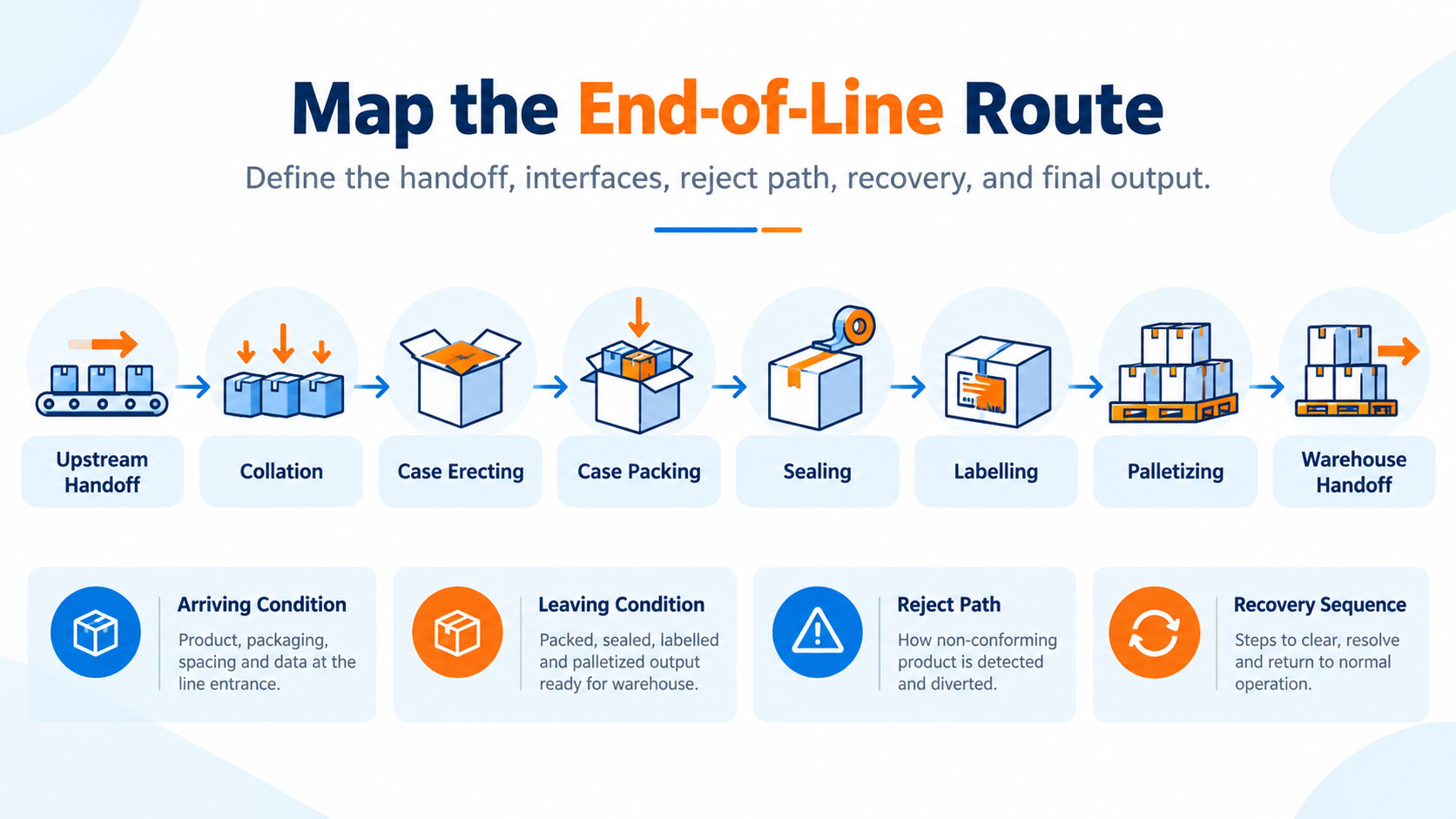
Begin at the agreed upstream handoff. Record product orientation, spacing, rate range, accumulation condition, quality status, and stop behavior. Continue through collation, case erection, loading, closure, identification, palletizing, and final discharge.
A machine list is not enough. Every arrow between machines needs an arriving condition, acceptable leaving condition, signal, reject path, and recovery sequence. These handoffs are where an apparently complete proposal can retain major gaps.
Decide what should be integrated
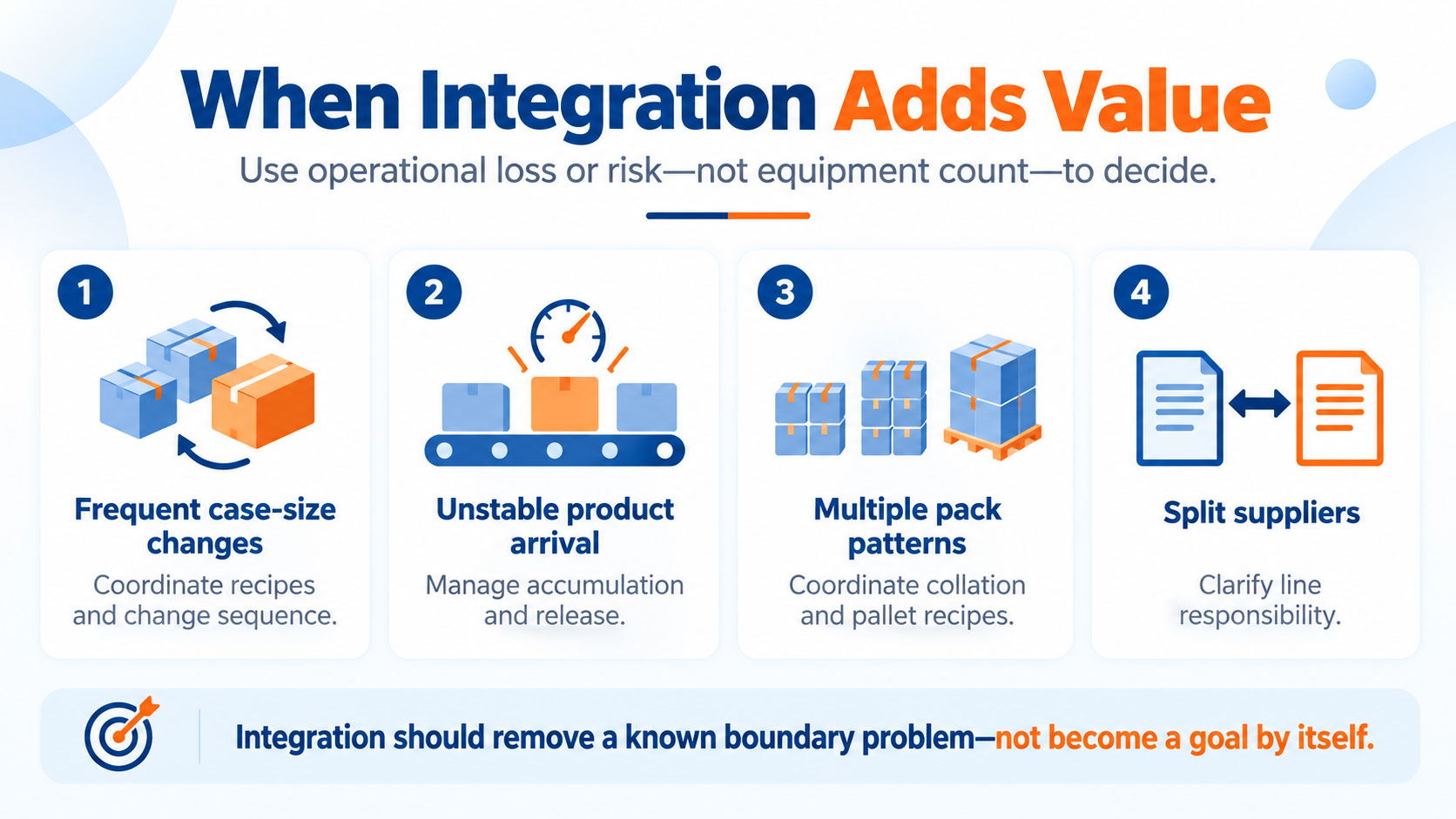
Integrated scope can reduce interface ambiguity when one party owns the control sequence and line test. It can also increase project size and complexity. Use the actual loss or risk to decide.
| Condition | Integration may help | Question to resolve |
| Frequent case-size changes | Coordinate recipes and change sequence | Which adjustments remain physical? |
| Unstable product arrival | Manage accumulation and release | Can the product wait safely? |
| Multiple pack patterns | Coordinate collation and pallet recipes | How are recipes verified? |
| Split suppliers | Clarify line responsibility | Who proves recovery across interfaces? |
Keep simple, stable tasks simple when there is no operational reason to combine them. Integration should remove a known boundary problem, not become a goal by itself.
Case forming and supply are production constraints
An automatic robotic case erecting machine relies on consistent carton blanks, replenishment, erecting, and bottom closure. Variation in board, storage, print, or case dimensions can affect downstream packing even when the packer is capable.
Define case range, loading method, magazine replenishment, low-material response, malformed-case handling, and changeover. Ask what happens to incoming products if no acceptable case is available. The line needs a controlled hold, divert, or stop response rather than an improvised accumulation point.
Collation and packing begin upstream
For applications requiring fixed rows or layers, a layer-forming case packing solution can coordinate product counting, orientation, grouping, and case loading. If primary packs arrive rotated, touching, damaged, or with random gaps, the end-of-line system must either correct the condition or reject it before grouping.
Specify every pattern that matters commercially. Show whether products are placed flat, on edge, stacked, wrapped as a bundle, or loaded into a display-ready case. Representative products and packaging should be tested because a rigid carton and a soft pillow pack behave differently under the same transfer.
Closure, labels, and data need one product identity
Case sealing, print-and-apply labelling, code verification, and tracking should use an agreed product and recipe identity. Define who creates and approves the data, how the correct record reaches each device, and what happens if a code or label fails.
Reject confirmation matters. A line should not merely issue a reject command; it should maintain control of the affected case and its status. The necessary method depends on the application and must be validated in the project.
Palletizing is part of the flow, not an isolated robot
A collaborative palletizing robot must be selected according to case weight, pallet pattern, stacking height, reach, and required throughput. Case quality can limit grip reliability and stack stability before robot payload becomes relevant.
High-mix plants should define pallet patterns, change frequency, partial-pallet rules, slip sheets, labels, empty-pallet supply, and recovery after a stop. If warehouse collection cannot remove completed pallets at the planned rhythm, the end-of-line constraint simply moves to discharge.
Make recovery visible
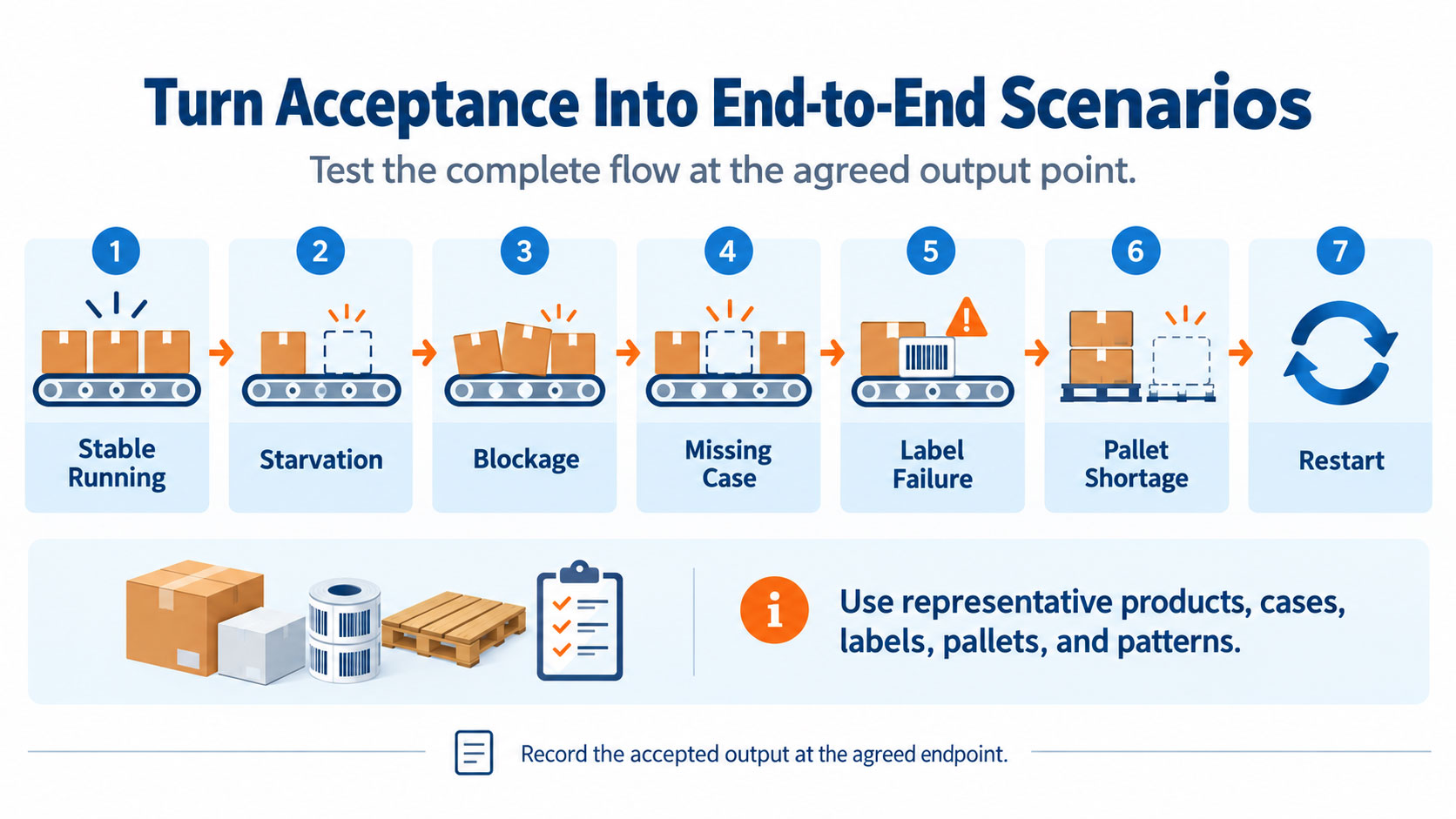
Clean continuous running proves only one condition. Test starvation, blockage, missing case, failed label, product reject, pallet shortage, emergency stop, and normal restart. Define the status of products already between machines.
OMAC's packaging guidance promotes consistent machine states and behaviors that can support interoperability and troubleshooting. A project may use different control architectures, but the responsibility map must still say which machine commands the line response and which supplier proves it.
Scope safety and access as a system
Guarding one machine at a time can create gaps where conveyors, pallet handling, manual stations, or maintenance access connect. Risk assessment and safeguarding require project-specific engineering and applicable standards; this article does not define a compliant solution.
Include normal operation, replenishment, cleaning, fault clearing, teaching, maintenance, and recovery. OSHA's industrial robot guidance emphasizes that a robot system includes the robot, end effector, controls, sensors, interfaces, and integrated equipment. That system view is directly relevant to robotic end-of-line cells.
Compare three common architecture choices
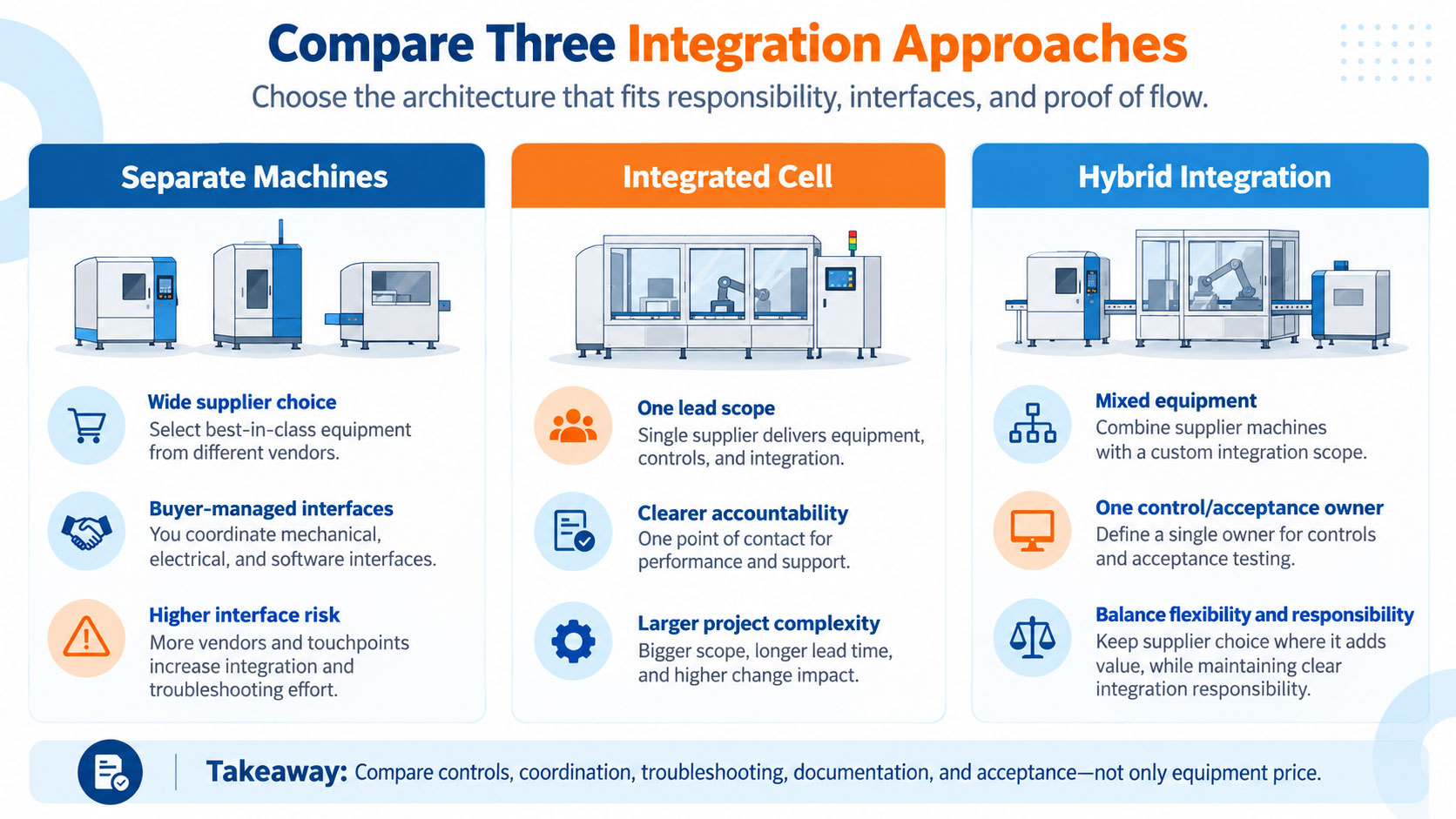
An end-of-line project can be organized as separate machines with buyer-managed interfaces, an integrated cell from one lead supplier, or a hybrid in which one supplier owns controls and acceptance while selected equipment comes from others.
Separate machines may preserve supplier choice and suit a plant with strong internal integration capability. The risk is that interface and recovery work remains with the buyer. A single integrated scope can clarify accountability, but it requires careful review of exclusions and third-party components. A hybrid can balance both, provided the lead integrator has authority and every supplier accepts the test plan.
Compare architectures against the same responsibility matrix. Count not only equipment price but also controls engineering, site coordination, simulation, installation, troubleshooting, documentation, and the cost of proving the complete flow.
Design layout around movement and intervention
Equipment footprints are only the beginning. Show empty-case delivery, packaging-material replenishment, reject removal, empty-pallet supply, slip-sheet loading, full-pallet discharge, forklift routes, operator stations, maintenance access, and guarding.
Consider the sequence during a fault. If an operator must enter a guarded area, determine what product remains in transit and what must happen before reset. If a palletizer tool needs maintenance, show how it is accessed or removed. If a case magazine is replenished manually, keep the task away from conflicting vehicle movement where the site assessment requires it.
Future expansion space should connect to a defined scenario. A blank rectangle on a layout is not proof that a later machine will integrate. Reserve transfer height, utilities, network capacity, control interfaces, guarding boundaries, and material routes.
Build a throughput model from work content
For each SKU, calculate the work that occurs between accepted upstream output and completed pallet. Include grouping, case erection, loading cycles, closure, labelling, layer building, pallet exchange, and planned components. Then add changeovers and normal replenishment.
The purpose is to identify which task constrains each format. One SKU may be limited by case packing; another by label application or pallet pattern. A single average rate can hide both. Show assumptions and confirm them with representative samples.
Use the model to decide where accumulation is useful. A buffer before a predictable short task may improve flow. Accumulation placed before a chronic constraint may only delay the stop and increase work-in-progress.
Define manual modes without creating hidden labor
Most automated lines retain manual tasks: loading blanks, replenishing labels, clearing rejects, handling damaged pallets, changing tools, or completing unusual formats. State those tasks in the proposal and estimate when they occur.
Manual bypass can add resilience, but it needs safe access, product handling, quality control, and a clear route back to automatic operation. An undefined “manual mode” can become the normal workaround for unresolved integration problems.
Ask who is needed during startup, changeover, recovery, and maintenance. The answer should match the plant's shift structure rather than an ideal commissioning team.
Turn acceptance into end-to-end scenarios
Test the line with representative products, cases, labels, pallets, and patterns. In addition to stable running, include material replenishment, SKU transition, case reject, label failure, pallet shortage, downstream blockage, and restart.
Record accepted output at the agreed endpoint. If palletizing cannot be installed at the supplier site, define what will be simulated and what moves to SAT. The limitation should be visible in the acceptance record.
An integrated project earns its value when the buyer can test one operating story across all equipment and hold a named party responsible for closing gaps. Without that, several connected machines may still behave like separate projects.
For a Soontrue Group scope review, prepare representative products and cases, the SKU and pallet-pattern matrix, current layout, desired handoff points, staffing assumptions, and the interfaces that have caused or may cause production loss.
What an integrated RFQ should contain
- Product, primary pack, case, pallet, and pattern matrix.
- Normal, minimum, and disturbance flow conditions.
- Layout, access, material routes, and warehouse handoff.
- Recipe ownership and data flow.
- Reject and product-disposition logic.
- Starved, blocked, stopped, and recovery scenarios.
- Mechanical, electrical, controls, safety, and documentation boundaries.
- Representative acceptance tests at the agreed output point.
Soontrue Group can support a complete-line scope discussion across case handling, packing, sealing, and palletizing where the application evidence supports it. The useful next step is not a generic equipment list; it is a product-flow and responsibility review built from the buyer's formats and layout.
Frequently asked questions
Q1: What is included in end-of-line packaging automation?
The scope may include product collation, case erecting, case packing, sealing, labelling, inspection, palletizing, pallet handling, conveyors, and integrated controls. The final boundary should be defined from the actual product route rather than a standard equipment list.
Q2: When should end-of-line machines be integrated as one system?
Integration is most useful when machine interfaces, frequent format changes, recovery sequences, or split supplier responsibilities create material production risk. Stable low-variation operations may not need the same integration depth.
Q3: How should end-of-line capacity be calculated?
Use the complete work content for each SKU, including grouping, case forming, loading, sealing, labelling, palletizing, pallet exchange, and normal replenishment. Compare the stages on one rate basis and identify which task constrains each production scenario.
Q4: Does adding more accumulation prevent line stoppages?
Not by itself. A buffer should protect against a defined interruption for a defined period while preserving product condition and identity. Accumulation placed before a chronic constraint may only delay the stop and increase work in progress.
Q5: What should an end-of-line FAT test?
Test representative formats, normal production, starvation, blockage, missing or rejected products, pallet shortages, changeovers, restart logic, and the agreed output condition. Any equipment unavailable at FAT should be simulated where practical and listed for site acceptance.