
- Home
- News
- Industry insights
-
How Packaging Protects Cookie Crispness
How Packaging Protects Cookie Crispness
Packaging helps protect cookie crispness by limiting moisture transfer between the product and its environment and by maintaining a consistent seal around the pack. Crisp cookies are low-moisture products, so exposure to humid air—or moisture migrating from a filling or another component—can soften their structure. The package can slow that change, but the result also depends on formulation, baking, cooling, product temperature, seal integrity and distribution conditions.
Quick answer: Cookie crispness is strongly affected by moisture uptake and water-activity changes. Packaging works as part of a control system: the material provides a moisture barrier, the sealing process closes that barrier, and handling and storage determine whether the barrier remains intact.
Why Crisp Cookies Become Soft
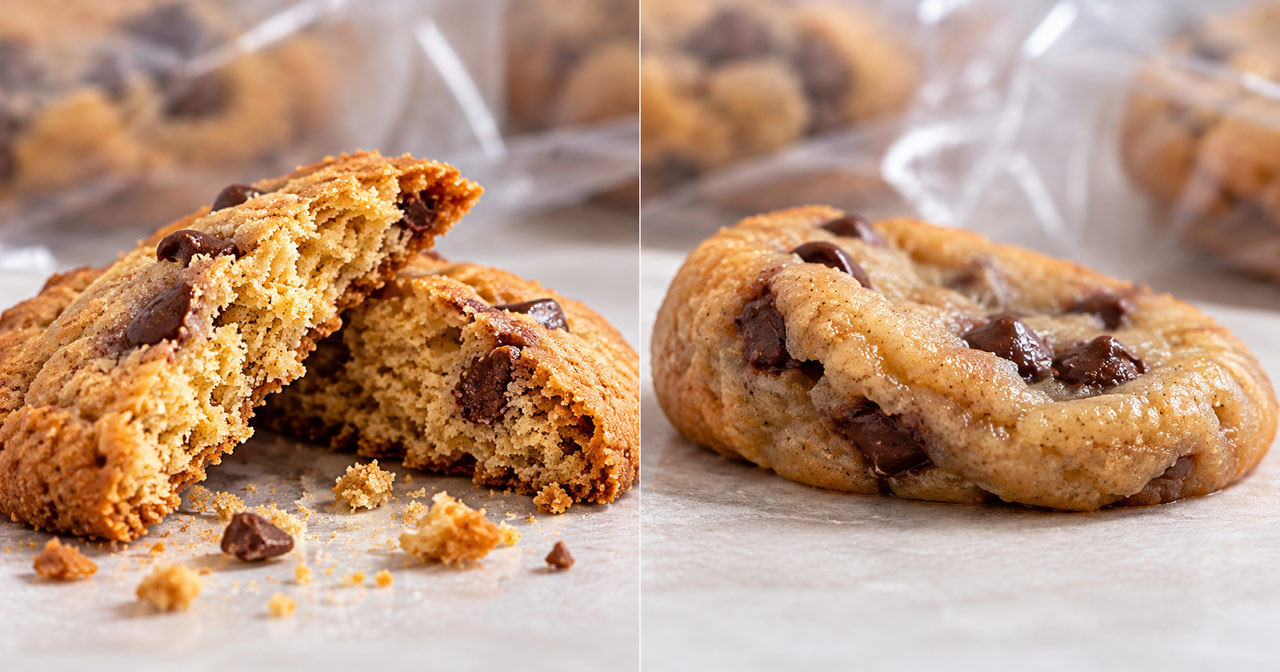
Crispness is a mechanical and sensory property. A crisp cookie fractures with a characteristic snap because its structure remains relatively rigid. When the product absorbs moisture, parts of that structure become more mobile and less brittle. The cookie may bend or compress rather than fracture sharply.
The change does not depend on one universal moisture number. Cookie formula, thickness, inclusions, filling, surface coating and storage temperature all influence the relationship between water activity and perceived crispness. Published work on biscuits and wafers consistently shows that moisture uptake, water-activity change and package conditions are connected to texture loss, but the critical point varies by product.
For manufacturers, the practical question is not simply "Is the cookie dry?" It is "How much moisture change can this specific product tolerate before consumers notice unacceptable texture?"
Moisture Can Enter from More Than One Direction
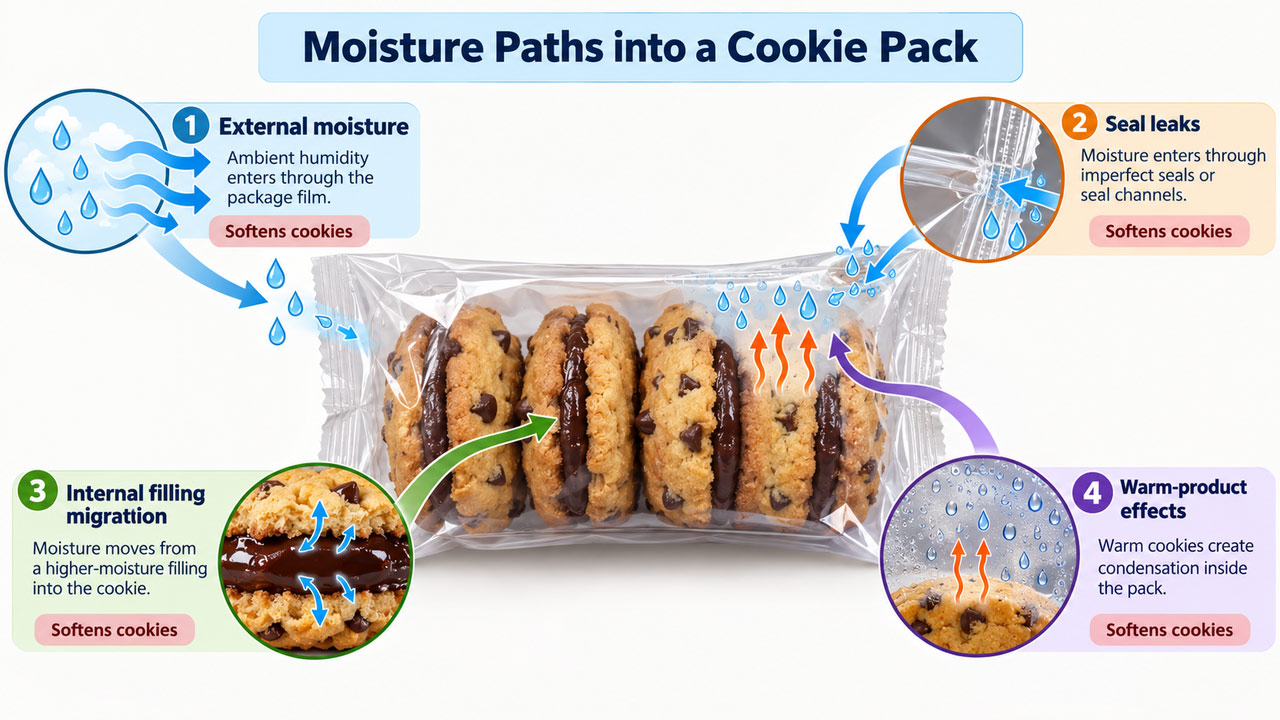
Ambient humidity is an obvious source. If the water activity of a dry cookie is lower than the surrounding environment, the product tends to absorb moisture until the system moves toward equilibrium. A package with insufficient water-vapor protection, a leaking seal or repeated opening can accelerate exposure.
Moisture can also move within the product. A sandwich biscuit, cream-filled wafer, jam-centred cookie or coated product contains components with different water activities. Water may migrate from the wetter component toward the drier, crisp component even when the outer package is well sealed. In that case, improving only the external film barrier may not solve the complete texture problem.
Cooling and packing conditions create another path. Cookies entering the package too warm can affect the package environment. Temperature changes during production or distribution can also create local moisture conditions that were not present during a laboratory test.
What the Packaging Material Does
The packaging material controls how quickly water vapor and other gases can move through the package structure. For crisp cookies, water-vapor barrier is usually a central selection factor, but it is not the only one.
Packaging teams may need to consider:
- water-vapor transmission under relevant temperature and humidity;
- oxygen barrier when oxidation of fats or flavors is a concern;
- sealant-layer compatibility and sealing window;
- stiffness, puncture resistance and flex-crack risk;
- print, registration and machinability requirements;
- opening, reclosing and portion-use behavior;
- product protection during secondary packing and distribution;
- material-reduction or recyclability objectives.
A material described as "high barrier" is not automatically the correct choice. Barrier data must be interpreted against pack surface area, required storage time, seal design, product tolerance and distribution environment.
Seal Integrity Completes the Barrier
The film structure can only perform as intended if the finished package is closed consistently. A channel leak, wrinkle, fold, contamination or damaged seal can create a faster moisture path than transmission through the film itself.
Cookie crumbs are particularly relevant. Broken particles or surface debris may reach the seal area, depending on product handling and package geometry. The packaging process should manage product position, film tracking, tension and seal clearance so that the sealing surfaces meet under controlled conditions.
Seal temperature, dwell time and pressure interact with material and line speed. Increasing one setting is not a universal correction. The usable sealing window should be established with the selected material and actual operating conditions, then checked across normal production variation.
From Cookie Problem to Packaging Requirement
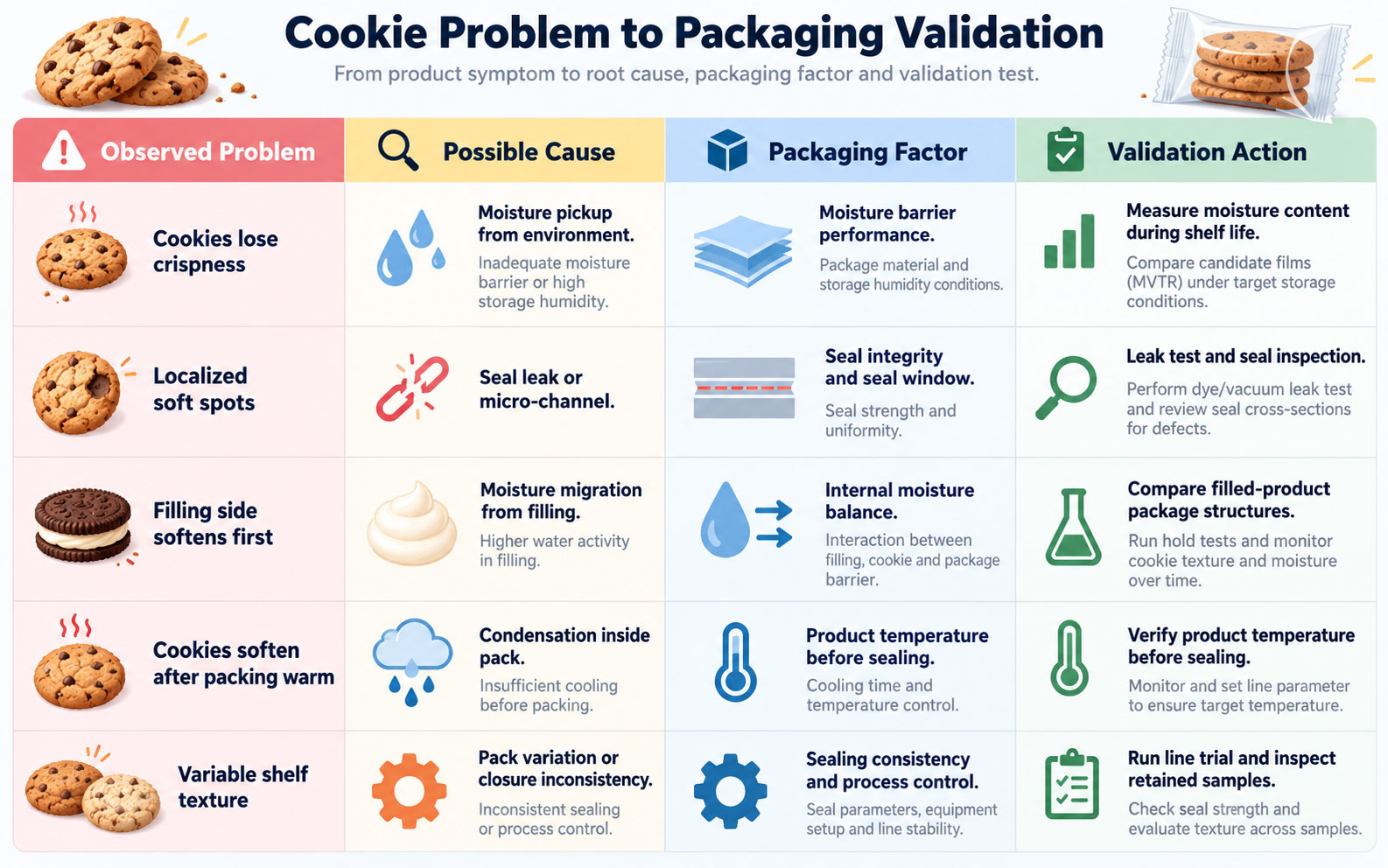
| Observed problem | Possible cause | Packaging factor to evaluate | Validation action |
| Cookies soften throughout the pack | Moisture entering through material or seals | WVTR, seal integrity, package damage | Compare product texture and water activity across controlled storage conditions |
| Only filled layers lose crispness | Moisture migration between components | Product formulation, internal barrier or component design | Test complete assembled product, not only plain cookie pieces |
| Intermittent soft packs | Variable seal or package damage | Seal contamination, wrinkles, handling and reject detection | Inspect failed packs and correlate with machine and material conditions |
| Softness appears after temperature changes | Condensation or changing humidity exposure | Cooling, pack timing and distribution profile | Reproduce expected temperature and humidity cycle |
| Product breaks before texture changes | Mechanical handling or insufficient protection | Feeding, drop, pack fit and secondary packaging | Run handling and distribution tests with real packs |
This sequence prevents a material specification from being treated as the only answer to a multi-variable problem.
Engineering Requirements Before Equipment Selection
The B2B engineering sequence is problem → requirement → process → equipment.
First, define the unacceptable quality change and the point at which it occurs. Next, translate that into measurable requirements for product condition, material barrier, seal integrity and package protection. Then define the process needed to cool, feed, wrap, seal, inspect and handle the cookies. Only after those requirements are clear should the team evaluate packaging equipment and line configuration.
Useful project inputs include:
- cookie dimensions, weight, brittleness and crumb generation;
- plain, coated, filled, stacked or grouped product format;
- product temperature and water activity at packing;
- target pack count, size and opening behavior;
- candidate film structure and sealant layer;
- normal speed, spacing and orientation;
- expected storage and distribution conditions;
- acceptable breakage, leakage and texture limits;
- sampling, seal-test and shelf-life protocol.
Packaging Cannot Replace Product and Process Control
Packaging may slow external moisture transfer and protect the product from damage, but it cannot compensate for every cause of texture loss. Formula, baking endpoint, component water-activity balance, cooling, hygiene, oil oxidation, storage and distribution remain part of the complete quality system.
Modified atmosphere or gas flushing may be considered for some products where oxygen-sensitive quality is relevant, but it does not automatically control moisture migration or guarantee crispness. Gas composition, barrier, sealing, residual gas and product response require separate validation.
Actual texture retention and shelf life must be validated using the real cookie, selected material, production process and expected distribution environment.
A Practical Validation Plan
A useful trial compares complete finished packs rather than film data alone. Record the starting product condition, material lot, machine settings, seal observations and storage environment. At planned intervals, evaluate pack integrity, product water activity, texture or sensory crispness, oxidation indicators where relevant and visible damage.
If a pack fails, identify whether the dominant path is material transmission, a seal defect, internal moisture migration, cooling/condensation or mechanical damage. That diagnosis determines whether the next action belongs to formulation, process, material, sealing or equipment handling.
Next Knowledge Step
The next guide should be Cookie Packaging Materials and Seal Validation Guide. It can compare the information needed from material suppliers, explain how to interpret barrier and sealing data, and show how to design a representative packaging trial. Readers who have already defined product, package and process requirements can then continue to Soontrue Group's Bakery Packaging Solution page for line-level context.
Frequently Asked Questions
Q1: Why do cookies lose their crispness?
Crisp cookies commonly soften when they absorb moisture from the environment or from a wetter filling or component. Formula, storage temperature and product structure also affect the change.
Q2: Does airtight packaging keep cookies crisp?
A package must have appropriate material barrier and consistent seals, but “airtight” alone is not a complete specification. Internal moisture migration, product condition at packing and distribution exposure can still affect texture.
Q3: What packaging material is best for crispy cookies?
There is no universal best material. Selection depends on the cookie, critical moisture change, required storage period, pack size, sealing process, handling and environmental conditions.
Q4: Can warm cookies be packaged immediately?
Packing while the product is still releasing substantial heat or moisture can change the package environment and may increase condensation risk. Establish an acceptable cooling endpoint for the specific product and process.
Q5: How should cookie packaging be tested?
Use the real cookie, candidate material, intended package format and representative production settings. Evaluate seals, water activity, texture, damage and storage performance under expected distribution conditions.