
- Home
- News
- Industry insights
-
Complete Packaging Line Planning for Recyclable Films and Multiple Pack Formats
Complete Packaging Line Planning for Recyclable Films and Multiple Pack Formats
A complete packaging line should not be declared compatible with recyclable films from a material label or one successful seal. Compatibility must be demonstrated across the product route: unwind and tracking, forming, sealing, coding, inspection, accumulation, secondary packaging, stops, restarts, and normal changeovers. When several pack formats share one line, the project also needs a controlled SKU matrix and an evidence record for every representative combination. The safest specification distinguishes proven materials, trial materials, and future concepts instead of placing all three inside one broad promise.
The EU Packaging and Packaging Waste Regulation began applying in phases from 12 August 2026. Its broader direction increases attention on recyclability, recycled content, minimisation, labelling, and reuse. Machinery teams should not interpret those legal requirements alone, but they do need a process for turning approved packaging decisions into testable line requirements.
Freeze the pack requirement before discussing machines
Recyclable is not a machine setting. Start with the package function: product protection, required barrier, seal integrity, opening behavior, print, coding, retail presentation, transport, and expected downstream handling. Confirm who owns the final material specification and regulatory assessment.
Build one row for each production-relevant combination of product, size, material, print, pack count, and secondary format. Mark its status as approved, trial, forecast, or excluded. Without that status, a forecast film can quietly become a contractual expectation even though no representative roll exists.
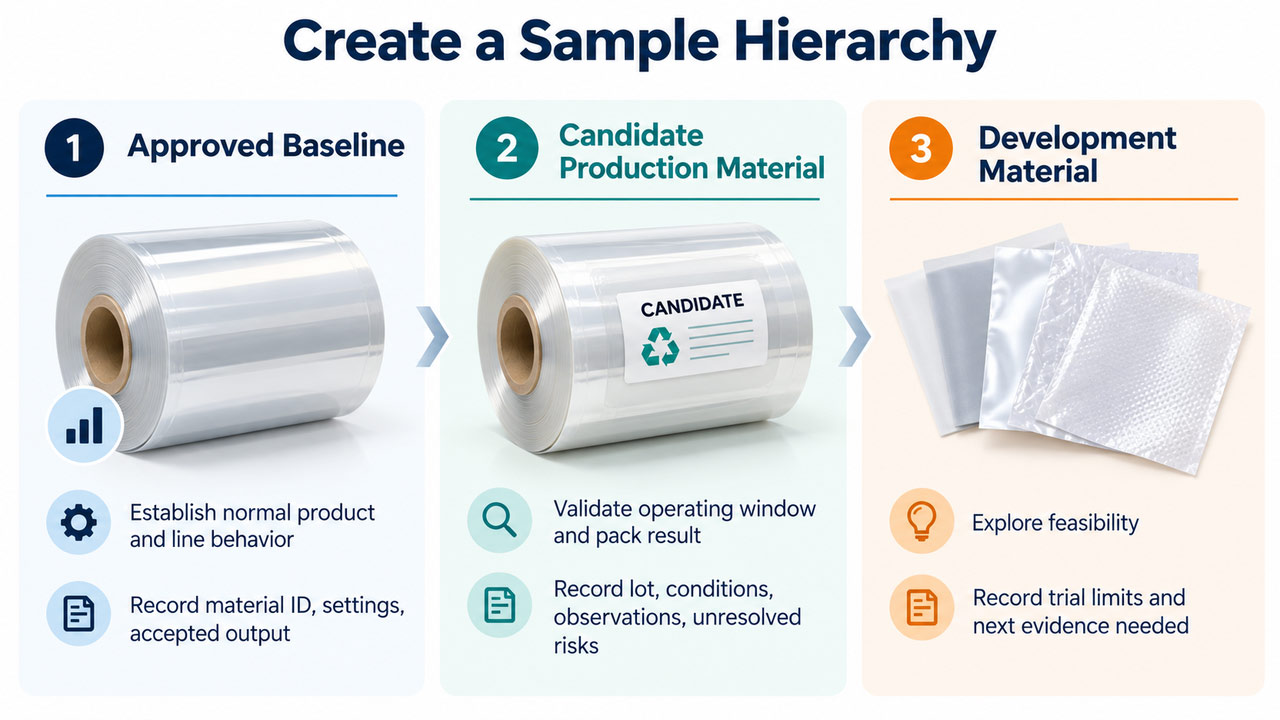
Create a sample hierarchy
Use the current production material as a baseline. It helps distinguish a new-material issue from a general machine or process issue. Candidate materials should arrive with lot identification and supplier data, while future concepts remain feasibility questions until samples are available.
| Sample class | Project use | Required record |
| Approved baseline | Establish normal product and line behavior | Material ID, settings, accepted output |
| Candidate production material | Validate operating window and pack result | Lot, conditions, observations, unresolved risks |
| Development material | Explore feasibility | Trial limits and next evidence needed |
The trial should use representative product conditions. Empty-film running may reveal tracking behavior, but it cannot prove how the material performs around a warm, fragile, dusty, irregular, or moisture-sensitive product.
Test the operating window, not one point
A short run at one speed can create false confidence. Observe startup, stable running, a planned stop, restart, material splice or roll change, and the transitions most likely in normal production. Record settings rather than relying on an accepted sample alone.
The objective is not to publish a universal sealing temperature or speed. Those values depend on the material, machine configuration, pack dimensions, environment, and product. The evidence should show what was tested and what remains outside scope.
Follow the material through the complete line
Changes at primary packaging can affect later stages. A different surface may influence code quality or vision contrast. A softer pack may collate differently. More air in the pack may change cartoning, case count, compression, or pallet stability. Static behavior can appear at transfers rather than at the sealing station.
Map these effects through coding, inspection, rejection, buffering, cartoning or case packing, labelling, and palletizing. The line trial should not stop at the first acceptable primary pack if the commercial output is an accepted case or pallet. Broader food packaging automation planning should also consider how material changes affect SKU flexibility, inspection, operator work, and coordination across the complete production line.
Soontrue Group can support complete packaging line integration and application review across primary packaging, inspection, secondary packaging, and downstream handling. However, only verified project scope should become a product claim. A conceptual process map is not evidence that every material has already run on a particular Soontrue configuration.
Plan multiple formats around common and exceptional work
List what stays common across formats and what changes: guides, forming parts, recipes, film width, coding, inspection settings, carton size, case pattern, and pallet recipe. Then map how often each transition occurs.
Frequently changed formats justify repeatable adjustments, preparation standards, and clear verification. A rare outlier may be better served with a separate module or controlled manual step. Designing every format for maximum automation can increase cost and recovery complexity without improving the production schedule.
Control changes after the trial
Material development often continues after equipment selection. Establish a change process for structure, thickness, supplier, coating, print, dimensions, and pack requirements. Each change should be reviewed for its effect on feeding, forming, sealing, coding, inspection, secondary packaging, settings, spares, and acceptance.
Retain an assumption register with owner, evidence status, and due date. This prevents a later sample from being treated as equivalent to the film used during the original test.
Connect primary-pack trials to coding and inspection
A material transition can change more than sealing. Print contrast, surface reflectivity, stiffness, static, and pack shape may affect code quality, vision inspection, label adhesion, checkweighing stability, or reject timing. Check these effects with the same representative sample used for the primary-pack trial.
Define the inspection sequence before testing. Record what constitutes an accepted code or pack, who reviews it, and how a failed item is tracked to the reject point. When a different material changes pack length or movement on the conveyor, trigger and reject positions may also need review.
Do not accept a statement that inspection "can be adjusted" without identifying the adjustment, access level, and validation step. The project needs repeatable settings and a known route back to production after a failed check.
Examine downstream pack behavior
Secondary packaging often reveals material effects that are not obvious at the wrapper. A pack may leave the seal area successfully but behave differently during collation, cartoning, case packing, compression, or palletizing.
Observe whether packs keep their orientation, slide consistently, build static, trap excess air, or change case fill. If the new pack is softer or more slippery, a grouping method that worked with the baseline may need different guides, timing, or handling. These are line-level consequences, not proof that the material itself is unsuitable.
Use the agreed commercial output point during the trial. If the project sells accepted cases, do not end compatibility evidence at the first acceptable primary pack. Retain samples from the beginning, middle, and end of the run where practical so the review is not based on one hand-selected item.
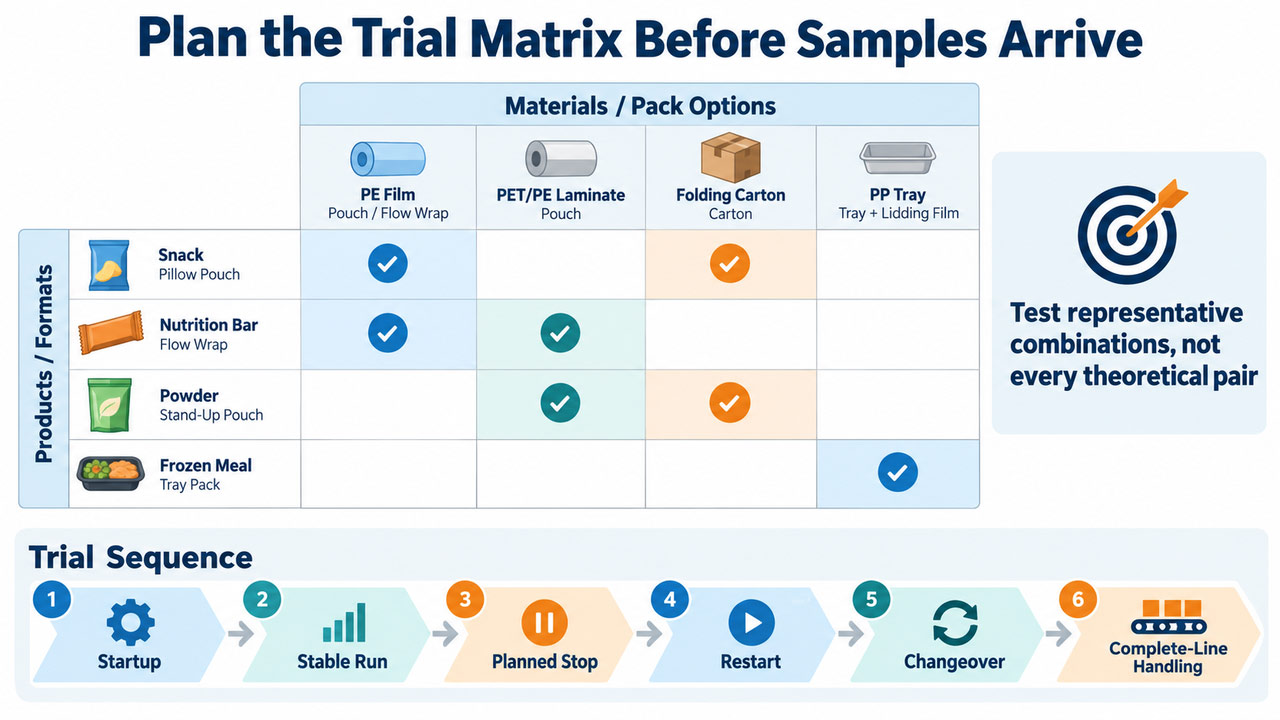
Design the trial matrix before samples arrive
A trial matrix prevents random testing and makes limited sample quantities more useful. Place products on one axis and materials or formats on the other. Select combinations that represent normal production and known limits rather than testing every theoretical pair.
For each selected combination, define the question being answered: basic feasibility, setting development, stable production, changeover, restart, inspection, or complete-line handling. A feasibility trial should not be reported as full production validation. Conversely, a full test does not need to repeat combinations that are genuinely equivalent if that equivalence is documented and approved.
Record the planned order. Running the easiest combination first may help commissioning; running the most uncertain combination early may protect the project schedule. The right sequence depends on sample availability and the decision that the test must support.
Compare proposals by their evidence plan
When suppliers describe material flexibility, ask how they will demonstrate it. A stronger proposal identifies the samples required, the stage at which they will be tested, the expected observations, the data retained, and the boundary between Factory Acceptance Testing (FAT) and site validation.
Compare responsibility for material sourcing, sample preparation, trial waste, settings, inspection, packaging-quality approval, and retesting after a change. Also check whether the proposed line preserves access for future trials and whether recipes can distinguish approved material versions.
Avoid scoring a supplier higher simply because its compatibility statement is broader. A narrower statement with a clear test plan may carry less project risk than a universal claim with no evidence path.
Define acceptance and unresolved risk
Acceptance criteria should come from the approved product and package requirement. Include the run conditions, output point, quality checks, sample status, and deviations allowed by contract. Do not invent universal thresholds for sealing, waste, rate, or efficiency.
At the end of each test, classify the result as demonstrated, demonstrated with conditions, not demonstrated, or not tested. Link every condition to an owner and next action. This format keeps commercial teams from turning "promising trial" into "approved for all production."
A complete-line material review is successful when the plant knows not only what worked, but also which combinations remain uncertain and how those uncertainties will be closed.
What the RFQ should request
- Product-and-pack matrix with confirmed and forecast combinations separated.
- Representative film and product samples, including lot identification.
- Defined trial sequence covering startup, stable run, stop, restart, and changeover.
- Pack-quality checks and the party responsible for acceptance.
- Complete-line observations through the agreed output point.
- Settings and sample records retained after the test.
- Explicit exclusions and open items.
- Change-control method for new materials and formats.
A reliable project does not promise broad material compatibility in advance. It creates a repeatable route from packaging requirement to sample, trial, evidence, and controlled production release.
Frequently asked questions
Q1: Can an existing packaging line run recyclable film without modification?
A1: Possibly, but the material label alone cannot confirm compatibility. The film should be tested through unwinding, tracking, forming, sealing, coding, inspection, accumulation, downstream packing, stops, and restarts using representative product and production conditions.
Q2: What samples are needed before evaluating a recyclable film?
A2: Provide the current approved material as a baseline and clearly identified rolls of each candidate material. Include the real product, print or coding requirements, pack sizes, and relevant secondary packaging so the trial reflects the proposed production route.
Q3: Why is one successful seal test not enough?
A3: A seal can look acceptable at one setting while the material remains unstable during speed changes, stops, restart, tracking, forming, or downstream handling. The test should identify a usable operating window and record the conditions under which accepted packs were produced.
Q4: How should multiple pack formats be included in the trial?
A4: Build a matrix of product, size, material, print, pack count, and secondary format. Select representative combinations that cover normal production and the difficult extremes instead of assuming one format proves every other combination.
Q5: What should be recorded after a material trial?
A5: Record material and lot identity, machine configuration, settings, run conditions, observations, quality checks, accepted output, failures, unresolved risks, and the approval status. Keep future or untested materials separate from combinations that have actually been demonstrated.