
- Home
- News
- Industry insights
-
Food Packaging Automation in 2026: Flexibility, Labor, and Sustainable Materials
Food Packaging Automation in 2026: Flexibility, Labor, and Sustainable Materials
Food packaging automation in 2026 is less about replacing one manual task and more about building a line that can absorb changing SKUs, constrained labor, new packaging materials, and tighter evidence requirements. A sound project starts with the product and pack portfolio, then defines material trials, feeding stability, inspection, changeovers, data, and responsibility across the complete line. Regulation and sustainability targets may influence the brief, but machinery compatibility still has to be demonstrated with representative products and materials. No equipment supplier can responsibly guarantee a new substrate from its name alone.
PMMI's 2026 industry report identifies SKU proliferation, workforce constraints, sustainability requirements, and tighter capital discipline as forces shaping equipment decisions. In Europe, the Packaging and Packaging Waste Regulation began applying on a phased basis from 12 August 2026. The operational consequence is not a single prescribed machine. It is a stronger need for documented packaging choices, controlled trials, and systems that can adapt without hiding unresolved risks.
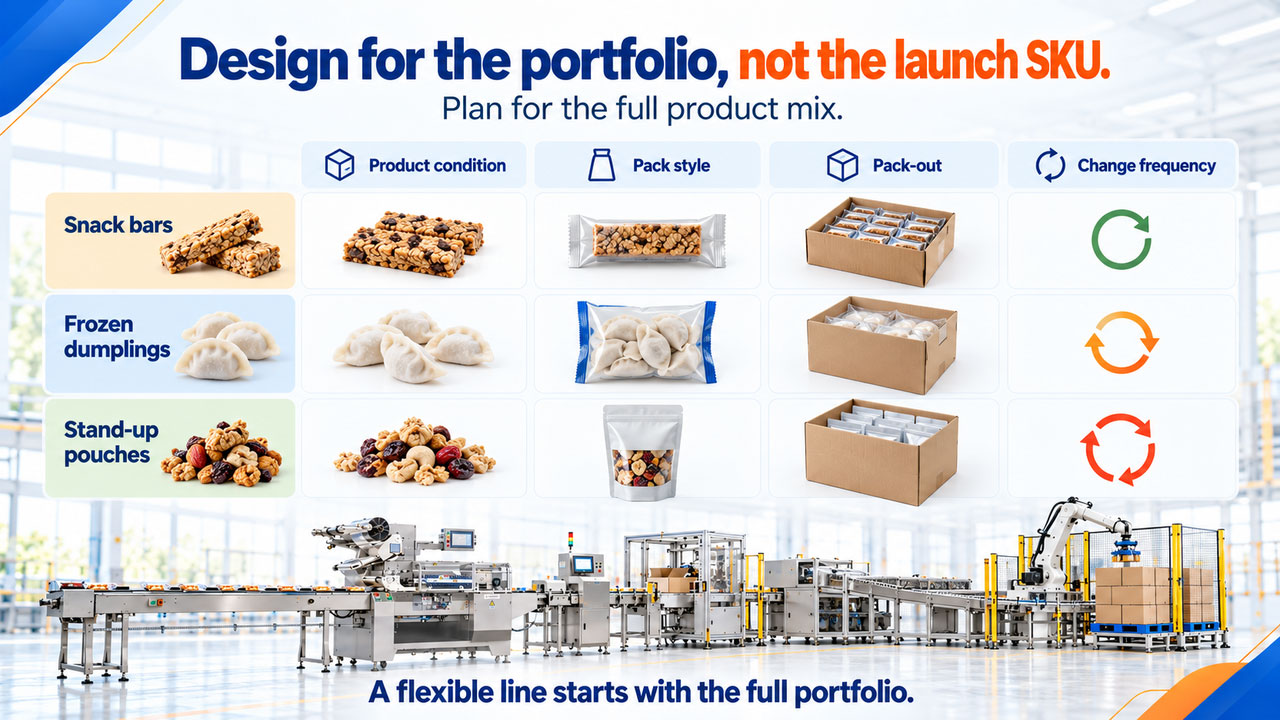
Priority 1: Design for the portfolio, not the launch SKU
Food plants rarely remain with one product, one pack size, and one artwork. Retail programs, portion changes, seasonal formats, and market-specific labels can turn a simple launch specification into a high-mix operating problem.
Start with a product-and-pack matrix. For every planned family, record product condition, normal variation, required orientation, count, primary material, coding, inspection, secondary pack, run length, and change frequency.
Separate confirmed products from forecasts. The line should not be contracted as though an untested future format were already proven.
This matrix helps decide where common equipment is sensible and where a variant needs a separate module or controlled manual step. Flexibility has value only when normal operators can repeat it and quality can release the next run without excessive uncertainty.
Priority 2: Put labor assumptions into the operating sequence
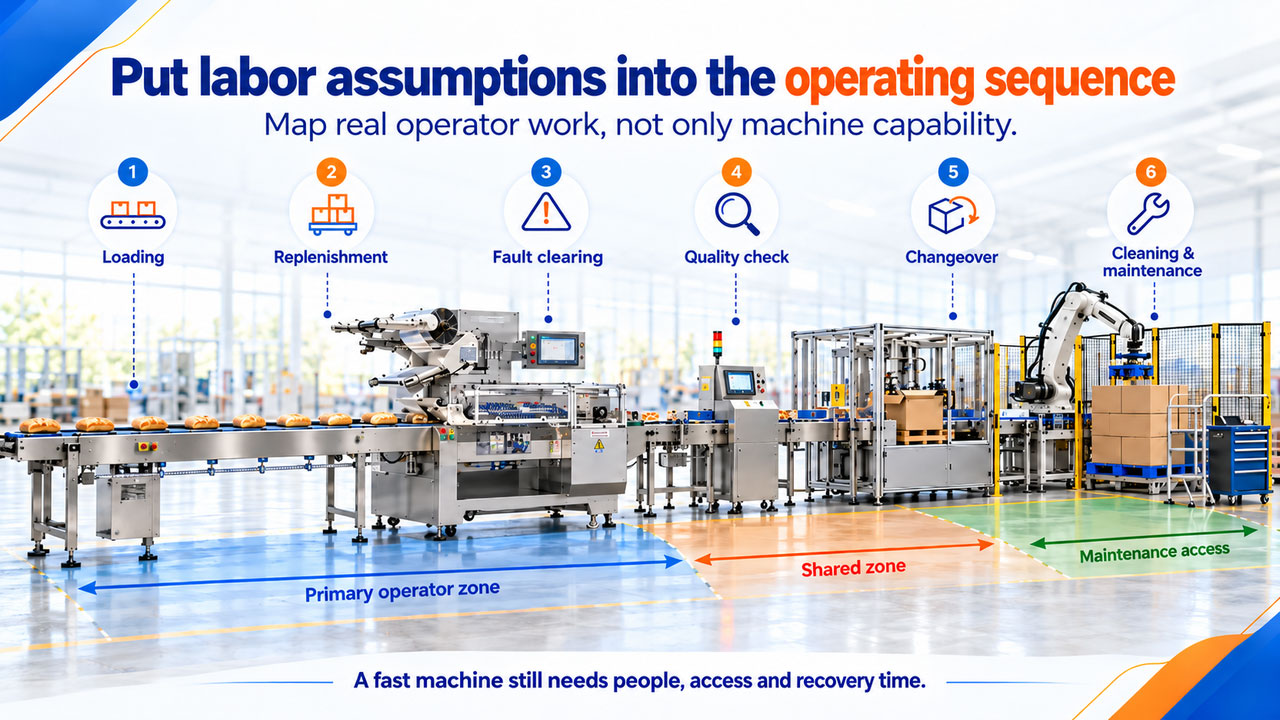
"Reduce labor" is too broad to design around. A project should identify who loads products, replenishes materials, clears faults, performs changeovers, approves quality, handles rejects, and restores production after a stop.
Automation can remove repetitive handling while creating new work in setup, recovery, cleaning, and technical support. A fully automatic feeder may be justified when upstream flow is stable; it may become a source of complexity when products arrive irregularly or frequently change orientation. The right scope depends on actual shifts, skills, and disturbance patterns.
Map operator touchpoints on the line layout. Include safe access, material routes, cleaning, inspection sampling, and maintenance. If two tasks are expected at the same time but assigned to one person, the design contains a staffing conflict even if every individual machine is capable.
Priority 3: Treat sustainable materials as a test program
Material descriptions such as recyclable, mono-material, recycled-content, paper-based, or compostable do not define sealing behavior. Suppliers still need the actual structure, thickness range, surface treatment, coefficient of friction, print, barrier requirement, and acceptable pack result.
The European Commission explains that PPWR applies in phases and includes measures concerning recyclability, recycled content, minimisation, labelling, reuse, and certain substances. This article is not legal advice. Packaging producers should confirm their obligations with qualified regulatory and packaging specialists.
For the machinery project, create a sample register:
| Sample | Status | What to test | Evidence retained |
| Current production material | Approved baseline | Forming, tracking, sealing, coding, inspection | Settings and accepted packs |
| Candidate material | Trial | Operating window and pack-quality risks | Lot details, settings, observations |
| Future concept | Unconfirmed | Feasibility only | Open questions and next test |
Avoid converting one successful short trial into a universal compatibility claim. Test representative speeds, stops, restarts, changeovers, and downstream handling. Film that seals during a demonstration may still track poorly after replenishment or behave differently when a printed lot changes.
Priority 4: Connect inspection and traceability to line behavior
Inspection equipment should not be treated as a detached checkpoint. Coding, vision, weight, metal detection, seal checks, and reject confirmation affect line states and product disposition.
Define what happens when a check fails. Does the line reject one pack, hold a group, or stop? How is a pack between machines classified after an emergency stop? Can the system prove that a rejected item left the product stream? Who can change inspection recipes, and how are those changes recorded?
These questions influence conveyors, spacing, buffers, controls, and access. They also affect restart time. A fast primary machine adds little value if inspection faults repeatedly leave operators uncertain about the status of products in transit.
Priority 5: Buy evidence, not adjectives
Terms such as flexible, intelligent, sustainable-ready, or future-proof need a testable meaning. Convert each one into an operating scenario.
- Flexible: Which product-and-pack transitions are included, and what physical work is required?
- Labor-efficient: Which tasks are removed, retained, or moved to technicians?
- Material-ready: Which exact samples have been tested, under what conditions?
- Integrated: Which supplier owns each interface and recovery test?
- Data-enabled: Which events and production values are available, and how will they be used?
A Soontrue Group discussion at this stage should focus on line scope, product flow, application trials, and responsibility boundaries. Product-specific claims still require approved Soontrue evidence; the planning framework is not proof that any particular configuration has already achieved the result.
Build change control into the project
Food and packaging specifications continue to evolve after equipment is ordered. The project needs a process for reviewing new materials, artwork, pack dimensions, products, and regulations without quietly expanding the guaranteed scope.
Maintain an assumption register with an owner and due date. When a change arrives, assess its effect on feeding, forming, sealing, coding, inspection, secondary packaging, controls, validation, spares, and training. Decide whether the change is included, deferred, or requires a new trial.
This discipline protects both buyer and supplier. It keeps commercial decisions connected to engineering evidence and prevents late changes from appearing as unexplained commissioning problems.
Include cleaning and product-zone access in the automation decision
Food applications differ in product risk, cleaning method, allergen controls, environment, and required access. The automation brief should identify the applicable plant standards and qualified reviewers rather than assuming one hygienic concept fits every product.
Map how operators remove residual product, access belts and guides, inspect hidden areas, manage cleaning tools, and confirm readiness before restart. A device that saves handling during production can add significant work if it creates inaccessible product traps or difficult disassembly. Those tradeoffs belong in layout and equipment review, not after installation.
Changeover planning should include product and allergen transitions where relevant. Keep the machinery discussion inside verified application facts: what must be accessed, removed, inspected, or protected. Do not make food-safety or hygienic-design claims for a Soontrue product without approved technical documentation for the exact configuration.
Use a staged automation architecture
When demand, materials, or product formats are still changing, a staged design can reduce commitment risk. The first phase may stabilize primary packaging and inspection while preserving interfaces for later automatic feeding, secondary packaging, or palletizing. Another project may justify complete-line integration from the start because the handoffs are already known constraints.
The staged plan should be real, not a vague promise of future expansion. Reserve floor space, utilities, controls capacity, product transfer height, data interfaces, and safety boundaries. Document which future rates and formats are assumptions. Otherwise, the later phase may require replacing the very equipment that was described as expandable.
Evaluate each phase against a complete future flow. Local optimization in phase one can create an awkward product orientation or accumulation method for phase two.
Ask suppliers for a decision record
A useful proposal should explain why a feeding concept, packaging process, inspection location, buffer, or secondary-packaging method was selected. It should identify the samples reviewed, assumptions used, risks still open, and tests needed.
This decision record is more durable than a feature list. When a material or SKU changes, the plant can see which original assumption has moved and which parts of the line require review. It also improves handover from project engineering to production and maintenance.
Soontrue references in this article should be tied to that practical scope: application assessment, sample testing, complete-line planning, or interface review. They should not be inserted as broad claims that the company or equipment is automatically suitable for every food, market, or material.
Questions for a 2026 automation brief
- Which products and formats are confirmed, forecast, or excluded?
- What constitutes acceptable output, and where is it measured?
- Which material samples are approved, and which still need trials?
- What tasks remain manual during normal running, changeover, and recovery?
- How are inspection failures and products in transit handled?
- Which line states, production data, and records are required?
- Who owns each mechanical, electrical, controls, safety, and data interface?
- What evidence must be produced before acceptance?
Food packaging automation should give the factory a controlled way to produce its planned portfolio, not merely an impressive demonstration. The best 2026 projects make uncertainty visible early and use samples, scenarios, and responsibility maps to reduce it.
FAQ
A1: What should a food packaging automation project define first?
Start with the product-and-pack portfolio, required output, production sequence, packaging materials, quality checks, cleaning needs, and existing upstream and downstream equipment. This prevents the project from being designed around one launch SKU while ignoring the formats that create the real operating difficulty.
A2: How should labor reduction be evaluated in an automation project?
Map the work people perform during normal production, replenishment, changeover, inspection, cleaning, fault recovery, and material handling. Automation may remove one repetitive task while creating new setup, supervision, or recovery work, so the comparison should use the complete operating sequence.
A3: Can recyclable packaging materials run on existing equipment?
They may be suitable, but compatibility should be demonstrated with representative product and production-intent material. Evaluate forming, sealing, tracking, coding, inspection, stops, restarts, changeovers, and downstream handling rather than relying on the material description alone.
A4: What evidence should suppliers provide before acceptance?
Request a clear scope, product and material register, test method, observed results, pack-quality checks, changeover evidence, fault and recovery tests, interface responsibilities, and an open-item list. Numerical performance should be tied to named products, conditions, and measurement points.
A5: Should a food packaging line be fully automated at once?
Not necessarily. A staged architecture can be more appropriate when demand, product formats, evidence, or site conditions are still developing. Each stage should have defined interfaces and expansion assumptions so later automation does not depend on undocumented changes.
Sources
PMMI, 2026 Packaging Machinery State of the Industry, 14 September 2026.
European Commission, New EU rules on packaging enter into application, 11 August 2026.
European Commission, PPWR FAQ, 3 August 2026.